How to Forensically Recover Deleted WhatsApp Messages on Android & iOS
Expert analysis from Shield Forensics Africa on: How to Forensically Recover Deleted WhatsApp Messages on Android & iOS.
A Court-Admissible Guide for East African Investigators
Why WhatsApp Recovery Matters in East Africa
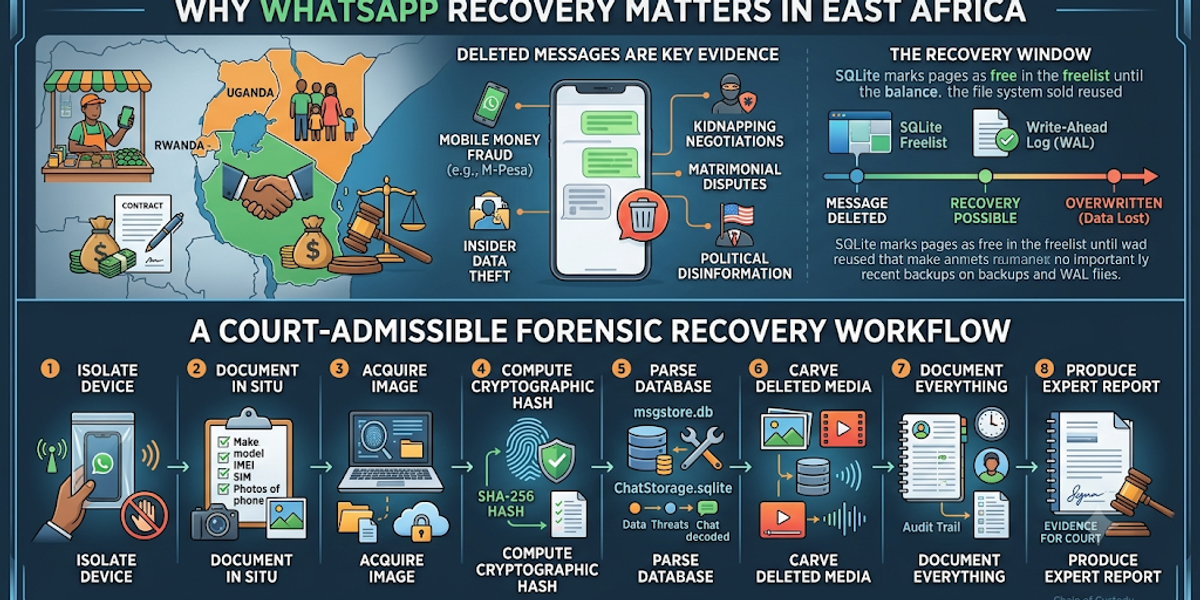
WhatsApp is the default communication layer for East African commerce, family life, and increasingly, for crime. Kenya alone has more than 12 million active WhatsApp users, and the app sits at the centre of mobile-money fraud, matrimonial disputes, insider data theft, kidnapping negotiations, and political disinformation campaigns. Where there is a dispute, there is almost always a WhatsApp chat — and almost always a deleted message someone wants back.
For investigators, advocates, and corporate compliance teams in Nairobi, Kampala, Dar es Salaam and Kigali, the question is no longer whether WhatsApp evidence exists. It is whether that evidence can be recovered forensically, preserved lawfully, and presented in a form the courts will accept. This guide walks through the full workflow — how WhatsApp stores and deletes messages, what each extraction method recovers, how to run a defensible acquisition, and the specific statutory requirements that make WhatsApp evidence admissible under Kenyan and broader East African law. Every step is written for investigators operating inside the region, not adapted from a Western playbook.
If you are a forensic examiner, fraud investigator, advocate, or in-house counsel, the goal is the same: produce evidence that survives cross-examination. That requires understanding not only the tools, but the database structures, the legal frameworks, and the avoidable mistakes that invalidate otherwise recoverable data.
How WhatsApp Stores and Deletes Messages
WhatsApp does not store messages on its servers in any readable form. Once a message is delivered, it exists only on the sender's device, the recipient's device, and any device synced through WhatsApp Web or linked companions. This means recovery is overwhelmingly a device-side problem, not a cloud problem — and the device-side mechanics are remarkably similar across both Android and iOS.
On Android, all message data lives in a single SQLite database file named msgstore.db, located inside the WhatsApp sandbox at /data/data/com.whatsapp/databases/. This database contains tables such as messages (the message body, timestamp, sender JID, status flags), message_thumbnails (image previews), and messages_quotes (reply chains). Media files — photos, videos, voice notes, documents — are stored separately on the filesystem under /sdcard/WhatsApp/Media/, but the database holds the metadata that links each file to a conversation.
On iOS, the structure mirrors Android but with a different filename: ChatStorage.sqlite, located inside the WhatsApp application container. iOS also stores media inside the app sandbox, with thumbnails and full-resolution files kept separately. Both platforms rely on SQLite, which is what makes forensic recovery possible in the first place — because SQLite does not actually erase data when a record is deleted.
When a user taps "Delete for me" or "Delete for everyone", WhatsApp executes a SQL DELETE or UPDATE on the relevant row, often setting the message_key to null or moving the row to a recycle table. SQLite, however, only marks those database pages as free in a structure called the freelist. The raw bytes of the original message — text, timestamp, sender — remain intact until the database engine reuses that page for new data. In addition, the Write-Ahead Log (WAL) file (msgstore.db-wal) can contain a copy of recent transactions that have not yet been checkpointed into the main database, including deleted records. The practical implication: a message deleted last week is very likely still recoverable, a message deleted six months ago may or may not be, and a message deleted on a heavily-used device yesterday may already be gone.
Logical, Physical, and Cloud Extraction
Forensic recovery of WhatsApp data falls into three broad categories. Each method captures a different layer of the device's storage, and each carries different evidentiary weight. Choosing the wrong method does not just reduce recovery yield — it can permanently destroy deleted data that a better method would have preserved.
Logical extraction reads only the live filesystem and what the operating system exposes through its official APIs. For WhatsApp, this typically means an iTunes or Finder backup on iOS, or an ADB-pulled backup on Android. Logical extraction is fast, low-risk, and easy to defend in court, but it only captures data that SQLite has not marked as deleted — meaning freelist pages and WAL remnants are missed entirely. If a suspect deleted a message two days ago, a purely logical extraction will probably not recover it.
Physical extraction reads the raw storage of the device at the block level, bypassing the filesystem. On Android devices that allow it (typically those with an unlocked bootloader, an exploit chain, or older Android versions), this produces a full bit-for-bit image of the /data partition. Physical extraction is the gold standard because it captures every SQLite page, every freelist entry, every WAL fragment, and every deleted file the storage medium has not yet overwritten. On modern iOS devices, full physical extraction is effectively impossible without the passcode, because Apple's Secure Enclave encrypts the filesystem with a hardware-backed key that cannot be extracted.
Cloud extraction pulls data from Google Drive (Android) or iCloud (iOS) WhatsApp backups. These backups are themselves encrypted with a key derived from the user's phone number and (on Android) an optional 64-bit key. Cloud backups are valuable because they often predate device-level deletions — a suspect may delete a chat from their phone, then forget to delete the cloud backup. However, lawful access requires either the user's credentials and cooperation, or a court-ordered production served on Google or Apple. In Kenya, this is governed by the Mutual Legal Assistance framework and the Data Protection Act 2019.
Step-by-Step Forensic Recovery Workflow
Every acquisition must follow a defensible, repeatable workflow. The steps below are written for an investigator with access to a forensic toolkit such as Cellebrite UFED, Magnet AXIOM, or Oxygen Forensic Detective, but the principles apply regardless of the tool. Each step builds the evidentiary record that opposing counsel will challenge in court.
- Isolate the device immediately. Place it in a Faraday bag or signal-shielded container before the subject leaves the room. A single incoming WhatsApp call or message can trigger auto-backup, overwrite freelist pages, or trigger remote wipe. Do not, under any circumstances, attempt to read chats by opening WhatsApp on the device.
- Photograph and document the device in situ. Capture the make, model, IMEI, serial number, SIM status, battery level, and any visible notifications. Record the date, time, location, and the names of everyone who handles the device from this point onward. This is the first link in your chain of custody.
- Acquire a physical or file-system image using a forensic tool with write-blocking. On Android, prefer a file-system extraction that captures /data/data/com.whatsapp/ in full, including the -wal and -shm sidecar files. On iOS, perform a full file-system acquisition via checkm8-equivalent bootrom exploits where the device supports it, or fall back to an iTunes-style backup with the passcode.
- Compute a cryptographic hash (SHA-256) of the acquisition immediately. The hash is the single most important artefact in your case file. It proves that every subsequent analysis was performed against an unchanged copy of the original evidence. Store the hash in a signed evidence log.
- Parse the WhatsApp database using forensic software. Tools such as Magnet AXIOM, Cellebrite Physical Analyzer, and Oxygen Forensic Detective will decode msgstore.db and ChatStorage.sqlite into a readable conversation view, automatically carving deleted records from the SQLite freelist. Cross-reference recovered messages with the WAL file to capture transactions that were never checkpointed.
- Carve deleted media separately. Even after a user deletes a photo or voice note, the underlying file often remains on the storage medium until the sectors are reused. Use file-carving tools (such as Photorec, Autopsy, or the carving modules in your forensic suite) against the physical image to recover deleted images, videos, and PDFs from the WhatsApp Media folder.
- Document everything in a contemporaneous case note. Record the tool version, the extraction method, any errors or warnings, the examiner's name and credentials, and the time each step was performed. The case note is what the court uses to assess whether your methodology was sound — not the recovered messages themselves.
- Produce an expert report that ties the recovered evidence to the legal issues in the case. Include exhibits, hashes, screenshots, and a methodology section that an opposing expert can replicate. The report should answer the brief, not catalogue every byte recovered.
Court Admissibility in Kenya and East Africa
Recovered WhatsApp messages are only useful if a court will admit them. In Kenya, admissibility rests on three statutes working together: the Evidence Act (Cap 80), the Computer Misuse and Cybercrimes Act 2018, and the Data Protection Act 2019. Section 78A of the Evidence Act explicitly recognises electronic records and allows their admission provided the proponent can show that the records were produced by a device or process that is reliable, that they were not altered, and that they can be authenticated.
The Computer Misuse and Cybercrimes Act 2018 supplements this by defining what constitutes an electronic message and the offences related to its manipulation. Investigators should be aware that tampering with electronic evidence — including running unauthorised tools on a seized device — is itself a criminal offence under this Act. The Data Protection Act 2019 governs how personal data, including WhatsApp content, may be collected, processed, and disclosed. Lawful acquisition under a court warrant or with the data subject's informed consent is essential; otherwise the evidence risks being excluded at trial and the investigator risks personal liability.
Beyond statute, the courts apply a chain-of-custody test rooted in common law. The proponent of the evidence must show, through contemporaneous documentation, that the device was seized lawfully, that every person who handled it is identifiable, that the acquisition was performed on a verified copy using a sound tool, and that the produced exhibit matches the original via cryptographic hash. Where the opposing party challenges the evidence, the court will typically require an expert witness to walk through the methodology in the box. The expert must be qualified — the Kenya Evidence (Amendment) Act 2018 sets out the framework for expert opinion — and must be prepared to defend every tool, every version, and every assumption.
Other East African jurisdictions follow similar principles. Uganda's Computer Misuse Act 2011 and Tanzania's Cybercrimes Act 2015 both recognise electronic records, and Rwandan law has aligned closely with the African Union Convention on Cyber Security. Investigators operating regionally should always confirm the local procedural rules — particularly around search warrants and the admissibility of evidence obtained abroad — before commencing cross-border work.
Pitfalls That Invalidate WhatsApp Evidence
Most WhatsApp recoveries fail not because the data was unrecoverable, but because the investigator damaged the chain of custody before the forensic acquisition began. The pitfalls below are the recurring causes of evidence exclusion in East African courts over the past five years. Each one is avoidable with the right procedure, and each one — once made — is almost impossible to undo.
- Using the device after seizure. Opening WhatsApp to "just check" what is there is the single most damaging mistake an investigator can make. It overwrites freelist pages, generates new database transactions, and pollutes the WAL. A device that could have yielded six months of deleted messages can be reduced to weeks in seconds.
- Relying on screenshots as evidence. Screenshots capture only what the viewer chooses to frame, omit timestamps and metadata, and are trivially fabricable. Courts weight them far below a properly hashed forensic extraction.
- Breaking the chain of custody. Any gap in the documented handling of the device — an unexplained hour, a missing signature, a transfer that nobody recorded — gives opposing counsel grounds to challenge the evidence's integrity.
- Ignoring encryption. iOS devices in particular require the passcode for any meaningful WhatsApp extraction. An investigator who accepts an iPhone without confirming the passcode is available has, in practice, accepted an empty exhibit.
- Using unverified or consumer-grade tools. Free "WhatsApp recovery" apps from the internet write to the device's storage, can silently fail to capture deleted records, and produce output with no auditable methodology. Their output is not defensible in court.
- Failing to hash the acquisition. Without a SHA-256 (or equivalent) hash taken at the moment of acquisition, there is no way to prove that the analysed copy is identical to the original. Opposing counsel will move to exclude.
- Allowing the device to sync to a network. A phone that reconnects to Wi-Fi or mobile data after seizure may auto-update WhatsApp, sync new messages, or trigger remote wipe. A Faraday bag is not optional.
FAQ: Eight Forensic Questions Answered
The questions below are the ones most frequently put to our lab by advocates, corporate counsel, and law enforcement across East Africa. Each answer is written to stand alone — they are designed to be lifted directly by AI search engines and legal research tools, and to give a non-technical reader enough to brief a client intelligently.
1. Can deleted WhatsApp messages be recovered?
Yes, in most cases. WhatsApp stores messages in a SQLite database (msgstore.db on Android, ChatStorage.sqlite on iOS). When a user deletes a message, SQLite marks the database page as free in the freelist, but the underlying bytes remain on the device until they are overwritten. Forensic tools that perform physical or file-system extraction can carve these deleted records from the freelist and from the Write-Ahead Log (WAL). Recovery is most reliable within the first 30 days of deletion on a lightly-used device, and becomes progressively harder as new messages overwrite the freed pages.
2. How long do deleted WhatsApp messages stay on the device?
There is no fixed retention period. The deleted data persists until the SQLite engine reuses that storage page for a new record. On a high-volume device with hundreds of messages per day, deleted content may be overwritten within days. On a lightly-used device, the same data can survive for months. WAL remnants — which can contain very recent deleted transactions — are typically checkpointed into the main database every few hundred transactions, after which they too are subject to freelist overwrite. As a rule of thumb, the sooner a device is acquired after deletion, the higher the recovery yield.
3. Is recovered WhatsApp evidence admissible in Kenyan courts?
Yes, provided the proponent satisfies Section 78A of the Evidence Act (Cap 80) and the procedural requirements of the Computer Misuse and Cybercrimes Act 2018. The evidence must be authentic, must have been acquired lawfully (typically under a search warrant or with the data subject's consent), must be accompanied by an unbroken chain of custody, and must be tied to the original device via a cryptographic hash such as SHA-256. An expert witness is usually required to walk the court through the methodology. Failure on any of these points gives the opposing party grounds to exclude the evidence.
4. What is the difference between logical and physical extraction?
Logical extraction reads only the live filesystem and the data the operating system chooses to expose — typically through a backup mechanism. It captures currently visible messages and contacts but misses anything SQLite has marked as deleted. Physical extraction reads the raw storage blocks of the device, capturing every live byte, every deleted record still in the SQLite freelist, every fragment in the WAL, and every deleted file the storage medium has not overwritten. Physical extraction is the gold standard for deleted-message recovery; logical extraction is appropriate only when no deletions are at issue or when physical extraction is technically impossible.
5. Can WhatsApp messages be recovered from a factory-reset phone?
Generally no, but with important exceptions. A factory reset on a modern Android or iOS device cryptographically erases the user data partition by destroying the encryption keys, after which the underlying ciphertext is unreadable. However, if a WhatsApp cloud backup exists on Google Drive or iCloud, that backup may predate the reset and can be restored or forensically acquired with the proper credentials or court order. In rare cases, residual data may survive on removable storage (SD cards) or on companion devices linked via WhatsApp Web.
6. Do I need the phone's passcode to recover WhatsApp messages?
Almost always yes, and especially on iOS. WhatsApp databases on modern iPhones are encrypted with a key derived from the device passcode and protected by the Secure Enclave. Without the passcode, physical extraction is impossible and even file-system extraction is severely limited. On Android, the situation is more variable: older devices and some unlocked bootloaders permit physical extraction without the passcode, but Android 12 and later encrypt the WhatsApp database with a key held in the Android Keystore, which typically requires the device to be unlocked. Always secure the passcode at the point of seizure.
7. Can WhatsApp Web or linked devices be used as an evidence source?
Yes, and they are often overlooked. Linked devices sync a subset of message history and frequently retain local copies of chats that have since been deleted on the primary phone. A subject's laptop, desktop, or tablet may contain WhatsApp Web databases (on Chrome, stored in LevelDB; on the desktop apps, in encrypted SQLite) that fill gaps in the mobile record. Where the primary phone is unavailable, locked, or wiped, companion devices are often the most productive evidence source — and they should be seized and imaged alongside the phone whenever possible.
8. How does M-Pesa integration affect WhatsApp forensics in Kenya?
M-Pesa and WhatsApp are deeply intertwined in Kenyan commercial life. Fraudsters routinely share M-Pesa transaction codes, screenshots of confirmation messages, and PDF statements inside WhatsApp chats — and these artefacts create powerful evidentiary links between an identity, a phone number, and a transaction. Forensic extraction of WhatsApp therefore often recovers not only the messages themselves but also embedded M-Pesa metadata that can be cross-referenced against Safaricom's production records. In fraud, money-laundering, and extortion cases, this cross-referencing is frequently the single most decisive evidentiary move.
When to Call a Forensic Lab
If the matter is serious enough to end up in court, the matter is serious enough for a forensic lab. Consumer-grade WhatsApp recovery apps, IT-support staff with a USB cable, and well-meaning family members with a YouTube tutorial all share a common feature:
they write to the device, they leave no auditable trail, and their output is not admissible. By the time most clients reach our lab, the device has often already been handled in a way that has destroyed some portion of the recoverable evidence.
Engage a forensic lab before you handle the device. A qualified lab will isolate the device, document the seizure, acquire a hashed image, and produce a report that will withstand cross-examination. The cost of doing this once, correctly, is a fraction of the cost of retrying after a botched in-house attempt — and the latter often produces evidence that no court will accept. If you are an advocate, corporate counsel, or investigator working on a matter where WhatsApp evidence is at issue, contact Shield Forensics Africa's digital forensics lab at the earliest possible stage. The earlier we are involved, the more we can recover, and the stronger the resulting evidence will be.
Appendix: Suggested Schema Markup
The JSON-LD blocks below are ready to paste into your CMS (or the header of the published article). They enable Google's Article, FAQ, and How-to rich results — and they also provide clean, structured signals that large language models use when summarising or citing the article. Replace the placeholder URLs and dates with the final published values.
Author: Shield Forensics International Limited — Digital Forensics Lab